Social Studies and ELA
Investigate context, geography, and civic questions. Read closely, compare accounts, discuss interpretations, and write from evidence.
New RST purchases cover one educator and their own students for 12 months and require annual renewal. School licensing for one RST title is $100 per year. District discounts apply. Read the annual terms and request a school or district quote. Previously accepted purchase terms remain applicable.
Collaborative Student Reasoning in Social Studies Education
Make student thinking visible through Research Simulation Tasks. Learners investigate questions, interpret sources, reason together, and explain what the evidence supports.
The RST Method by Terrence Knox connects historical understanding, student collaboration, and critical thinking. African and Indigenous perspectives, cultural responsibility, and Amistad Act implementation inform the work. Students examine sources, consider perspective, distinguish evidence from inference, and support their conclusions.
Investigate context, geography, and civic questions. Read closely, compare accounts, discuss interpretations, and write from evidence.
Calculate quantities, ratios, distances, or change. Explain what the result reveals and what the data cannot establish.
Ask a testable question, identify a measurable outcome, compare conditions, and acknowledge a limitation.
A flexible sequence for the interdisciplinary RST model. Teachers adapt scaffolding and extensions to the grade band and selected resource.
Activate prior knowledge with a Do Now, introduce context, and examine the first sources.
Read and map evidence, identify perspectives, and discuss agreements and differences.
Use calculation and scientific investigation to deepen the shared inquiry.
Collaborate, evaluate evidence, and explain which conclusions the sources support.
Complete the assessment and a RACE response, then reflect on the reasoning.
Daily Do Nows introduce the related reading or activity. Quick Writes follow it. I Do, We Do, and They Do guidance belongs in the separate teacher notes.
Preview a limited student sample from Why Government? Explore civic reasoning and source analysis, then review the complete weekly offer.
Explore the Free Limited SampleThis example illustrates the method. It is not an excerpt from the paid book.
Compare a map of rivers and settlements with a reading about trade. Identify patterns and ask what additional evidence would help explain them.
Use a map scale to estimate travel distance. Design a controlled comparison of how two soil samples retain water, using equal amounts of water and a measured outcome. Discuss the limits of using a classroom model to explain historical settlement.
Develop a claim about water access and settlement. Cite the map and reading, explain how each supports the claim, and identify one limitation.
Ma’at’s interdisciplinary RST model includes print and fillable student PDFs, separate teacher guidance, daily Do Nows and Quick Writes, source work, assessment, and RACE writing. Resource pages identify their grade bands, NJSLS and Common Core State Standards (CCLS) pathways, and included materials.
Digital written response fields allow 1,000 characters per field. Objective questions may be scored through the included Google Forms setup where offered. Written responses and RACE are teacher scored.
By Terrence Knox · 110 page PDF edition · $49.99
Explore the framework, classroom examples, and strategies behind collaborative student reasoning.
One reader license. Schoolwide sharing requires separate permission. Purchased downloads become available after payment is confirmed.
Discuss professional learning for your school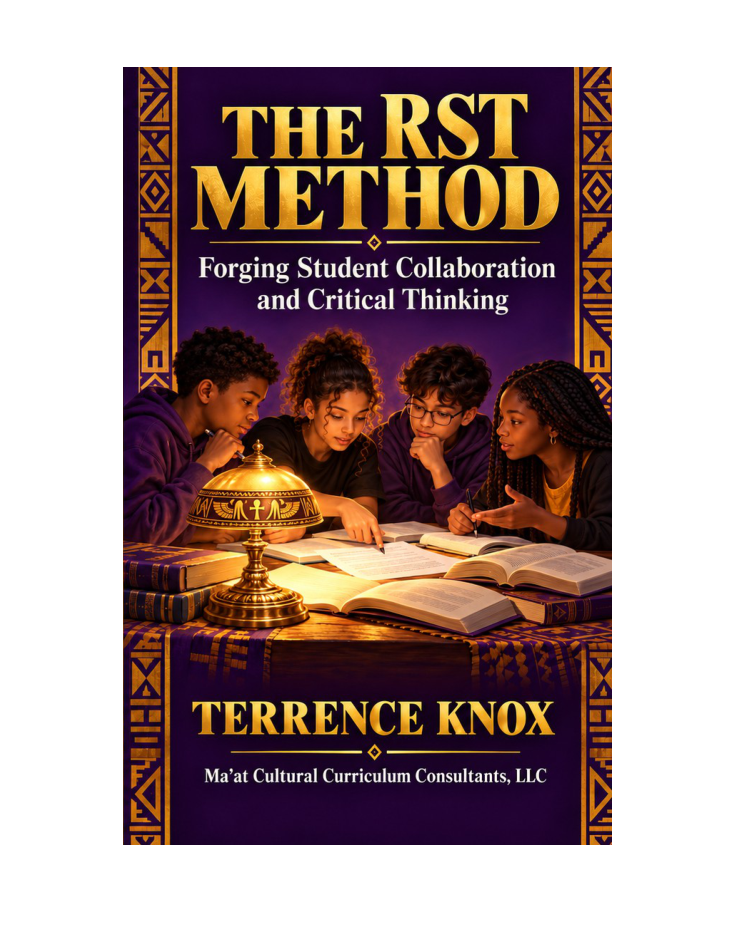
Intellectual Property of Ma’at Cultural Curriculum Consultants LLC Est. 2017.